
Reckless: The Saga of Australian Crawl by Jeff Apter
- NZ Booklovers

- 1 day ago
- 2 min read
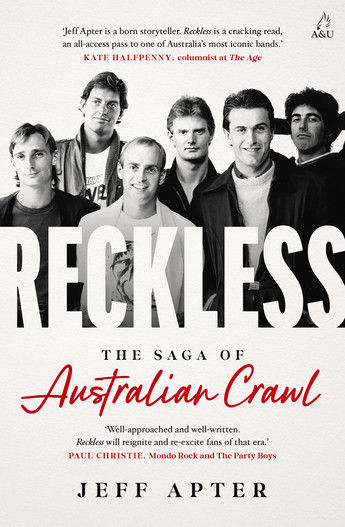
Renowned music biographer Jeff Apter’s Reckless: The Saga of Australian Crawl is a brisk, affectionate and clear-eyed account of a band whose public image has always been easier to recognise than to understand. Australian Crawl seemed, from a distance, to embody a particular kind of late twentieth-century Australian ease: beaches, pubs, tans, surfboards, sharp choruses and James Reyne’s unmistakable voice slicing through the radio. Yet Apter’s biography shows that beneath the sunlit exterior was a far more fragile story of ambition, miscommunication, ego, exhaustion and grief.
The book begins with the band’s early emergence from the Mornington Peninsula and their first appearance on Countdown in 1979, when their oddness was still part of their appeal. They did not arrive as polished industry products. They were high school friends with charisma, nerve and songs that sounded distinctly local without being parochial. From there, their rise was rapid. The Boys Light Up and Sirocco made them one of the defining Australian acts of their era, while songs such as ‘Beautiful People’, ‘Downhearted’, ‘Errol’, ‘Boys Light Up’ and ‘Reckless’ gave them a catalogue that has endured long beyond the band’s relatively short life.
Apter is experienced in this terrain, and his knowledge of music biography helps him balance momentum with context. He understands that the appeal of a band biography lies not only in chart positions and recording sessions, but in the strange chemistry of people who create together and then struggle to survive their own success. Australian Crawl’s internal dynamics provide rich material. Questions of songwriting credit, money, musical direction and status gradually corrode the original bonds, and Apter traces these tensions without reducing the band to a simple rise-and-fall morality tale.
The figure of James Reyne inevitably looms large. As frontman, lyricist and later solo star, he became the public face of Australian Crawl, but Reckless is careful to keep the wider group in view. Interviews with key members, including Bill McDonough, Paul Williams and Simon Binks, help shift the story away from a single-person legend and towards something more collective and more complicated. The death of guitarist Guy McDonough in 1984 gives the book its deepest emotional wound. Apter presents it not as a dramatic turning point inserted for effect, but as a loss that altered the internal life of the band in ways that success could not repair.
The book is particularly strong on the gap between image and reality. Australian Crawl were often framed as carefree surf-rock larrikins, yet their music was sharper and stranger than that label suggests. Their best songs carried irony, melancholy and a sly eye for social performance. Apter’s account respects the pleasure of the music while also showing how easily a marketable image can narrow a band’s perceived legacy.
There are places where the book’s pace may leave readers wanting fuller analysis of particular songs or albums. Apter is strongest as a storyteller and interviewer, less intent on extended musical close reading. Still, that choice keeps the narrative accessible and lively. Reckless succeeds as a portrait of a band that burned brightly, frayed painfully and left behind songs that remain embedded in Australian cultural memory. It is a cautionary tale, certainly, but also a reminder that even the most relaxed-sounding music can be made under pressure.
Reviewer: Chris Reed
Allen & Unwin


