
The Only Way is Up: On Foot to Rome by Jennifer Andrewes

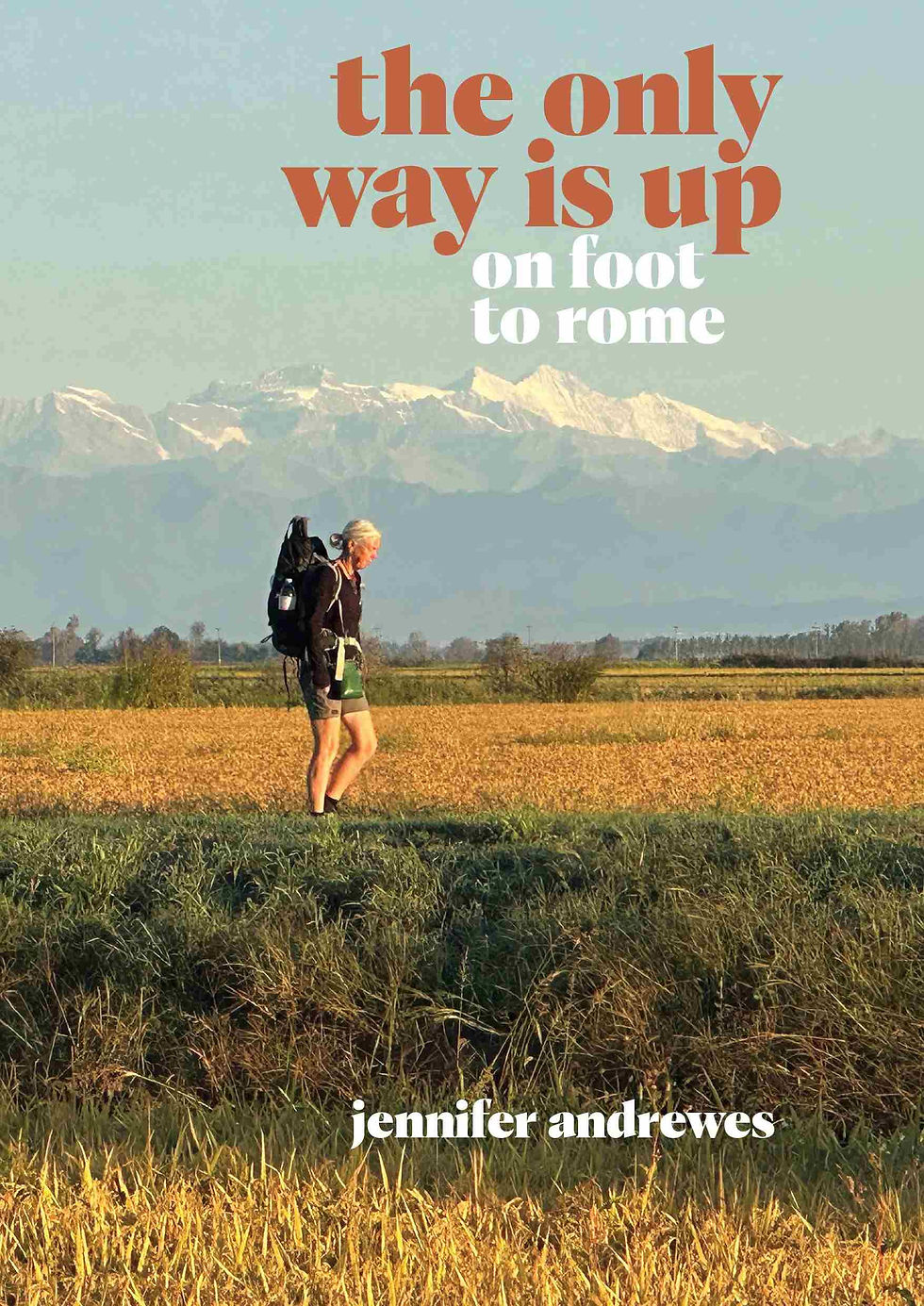
I feel a little guilty reading this book while curled up on a comfortable sofa. I’m warm and dry while immersed in Jennifer Andrewes’s 2000 km-plus pilgrimage on foot across challenging terrain from Canterbury (England) to Rome, along the Via (Romea) Francigena. Despite heat, rain, mud, mosquitoes, squelchy shoes and fatigue, she remains optimistic and resilient. Her story has many memorable highlights.
Andrewes vividly describes the highs, lows, and disappointments of walking a camino, what she sees and hears along the route, her hearty meals and morale-boosting snacks, and the ideas and experiences she shares with others. Although there are periods of intense solitude, her memoir is rich with encounters with other people – including fellow pilgrims, overnight hosts, café owners, and other locals. She also comes across menacing dogs, herds of cows, and the occasional snake or bull.
Andrewes has many reasons for walking.
I like the simplicity of walking ‘for what’: … what you encounter, do, feel, discover, learn … for the unknown. For what I can’t yet name. … I walk because I’m compelled to; because I must keep walking if I am to keep walking.
The last reason is a reference to Andrewes’s early-onset Parkinson’s disease, diagnosed in 2019. Although it appears to “loosen its grip” on the trail, she does not take her mobility for granted, aware that her freedom will eventually be limited.
The book has three main parts. Part 1, from Canterbury to Langres (France) focuses on the mental journey, Part 2 from Langres to Sarzana (Italy) covers the physical journey, and Part 3 from Sarzana to Rome addresses the spiritual journey. These mental, physical and spiritual dimensions intertwine throughout the book.
Andrewes’s daily accounts emphasise the step-by-step, day-by-day discipline required. The heading for each entry includes the start and end points, the distance covered, and either a short note about the day or a brief word of advice, such as: Mission possible; Under pressure; Live a life you will remember. Each day’s walk has its own playlist, drawn from an eclectic mix of contemporary and classical music. Performers range from Kermit to Kiri (as well as other iconic New Zealand musicians), with one song composed by Andrewes’s son.
Andrewes relies heavily on GPS for navigation, yet Wi-Fi and mobile coverage are inconsistent. In some areas, she must trust verbal directions from strangers or coloured arrows painted on trees. Inevitably, there are times when she has to backtrack, or a shortcut turns out not to be a wise decision. Perseverance and adaptability are essential.
The cover image captures the pilgrimage well. Andrewes looks thoughtful and determined as she walks alone through open fields surrounded by spectacular mountains, her backpack kept lightweight to make the walk manageable. Several sections of the book include colour photos of scenery, meals, and fellow travellers, along with a couple of sketches by Tom Christie. The images depict the changing climate and diverse landscape, including cliffs, lakes and fields, stark urban terrain, an unmonitored border crossing, and a road “stretching ahead in an apparently endless and shadeless curve”. A couple of basic maps identify key locations along the route. It would have been helpful if the book had an index or a more detailed map for readers interested in the featured locations. Still, there is plenty of information about the historic Via Francigena route online.
Despite previously having completed similar lengthy walks, some days Andrewes struggles.
By God, it is a long day…it’s one of those days when I check my map app every five minutes hoping that, by some miracle, 5 km will have vanished behind me. I’ve hit the tough third week of pilgrimage – the stage where everything feels harder before it starts to get easier.
Andrewes often mentions how grateful she is for “tiny mercies”. As well as the kindness of strangers who charge a phone or open a café out of hours, she appreciates the community facilities – such as rain shelters, picnic tables and sources of water – that both symbolise and provide support for pilgrims. Rituals are grounding, and she draws on “pilgrim resourcefulness” when the going is tough. She copes with headaches, tick bites, an upset stomach, poorly maintained tracks and relentless climbs. The ups and downs of the terrain mirror the mental ups and downs.
[Today] reminds me that pilgrimage is a swinging pendulum of hard stretches and easy ones, damp misery and sunlit bliss.
Overnight accommodation ranges from humble and rustic to indulgent. Andrewes tolerates noisy fridges, bells that peal hourly all night long, mosquitoes, clattering bunks, rowdy and snoring guests in shared lodging, raucous catfights, long drop loos and broken showers. One or two hosts are slightly creepy and there’s even the hint of a ghost. Her relief when she has a decent place to stay is unmistakeable:
Tonight, we’ve hit absolute gold. A little monastery apartment in the heart of fortified medieval Viterbo. Sheets! Towels! A proper door that closes!
Andrewes has a great eye for detail and her descriptions bring her story to life.
We pass tiny vegetable plots that someone has tended into perfection – elf gardens tucked behind hedgerows. Butterflies dance, caterpillars inch along stems and swallows stitch the sky.
She shares astute observations of the differences in architecture, rhythms of life, and landscapes across France, Switzerland, and Italy. She weaves in aspects of local history that place her journey within broader historical and geographical contexts, referring to local legends as well as fateful battles.
History lies heavy on this land, even as it now stands quiet under the sun. … Every step forward carries the memory of those who walked before.
Still, there was rarely time to linger in an area that Andrewes was passing through. If a site or museum she wanted to visit was closed that day or shut when she got there, she missed out – her priority being pilgrimage rather than tourism.
Andrewes’s ability to engage and connect with other walkers is a recurring theme throughout the book. In particular, she forges a strong friendship with Australian woman Citt, whose company is valued as they move towards a common goal, at times together and at times apart. Although not physically present for most of the walk, Andrewes’s partner and sons are with her in spirit. Yet there are times when she is overcome by loneliness.
Walking teaches me that company changes everything. The road is the same distance regardless but a shared snack, a laugh, a hug at the crossroads – they make the miles lighter … I chose this pilgrimage for the solitude … but I also realise I like and need company. It doesn’t have to be an either/or.
Anyone who has walked a camino or gone on a similar long tramp knows that food and drink are not only central to survival but also provide psychological comfort. Andrewes is nourished by treats such as pizza, pastries, and pumpkin ravioli, Chianti, charcuterie, and custard tarts. Meals – planned or improvised – are enjoyed indoors and outdoors, at shelters, picnic spots, formal dining rooms and trattoria, in the company of others and alone. Her vital daily coffee ranges from excellent to “lukewarm sludge”. On days when cafés or supermarkets are unexpectedly shut, leftovers found at the bottom of her pack become a feast.
Once I started reading, I was hooked, eager to cheer Andrewes on (albeit from my couch) and to see how her journey unfolded. Yet even if you have only a few minutes a day to read, this book is ideal. Most entries are only a page or two and all offer something to reflect on, or a new perspective on travel.
The epilogue affirms that “magic lives in the unexpected”. Overall, this memoir successfully combines both a travel narrative and thoughtful spiritual reflection. It shows that pilgrimage is not only about reaching a destination, it’s also about learning to endure uncertainty, to notice and appreciate small kindnesses, to adapt when plans go awry, and to discover meaning in the steady act of putting one foot in front of the other.
What lies ahead is unknown – and that, perhaps is the point. Pilgrimage is as much about trust as it is about endurance.
Reviewer: Anne Kerslake Hendricks
Parallel Lives


