The Blood Says Otherwise: A fascinating and heart-breaking story of life as a forensic scientist by Ruben Miller

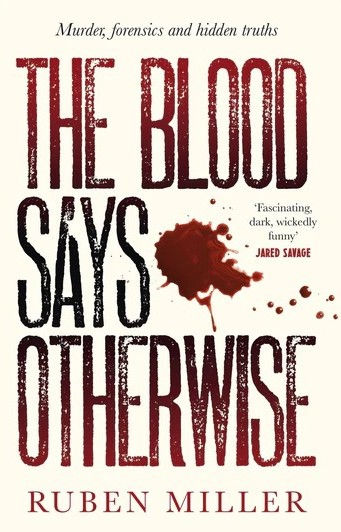
Part true crime and part memoir, this is an absorbing, confronting and surprisingly funny account of what it really takes to work at the frontline of forensic investigation.
Ruben Miller spent 22 years working as a forensic scientist across Aotearoa New Zealand, walking into crime scenes most of us would struggle to imagine. In The Blood Says Otherwise, he takes us behind the crime-scene tape and into the reality of forensic reconstruction.
Ruben worked closely with Police on some of New Zealand’s most difficult and high-profile cases. From cold-blooded killings to cold cases revived by one small clue, his job took him into homes and communities where something terrible had happened. He writes about the work with clarity and honesty, explaining the methods forensic scientists use to piece together what may have occurred. The details are often heartbreaking, but never gratuitous. Instead, Ruben shows how much care, patience and curiosity are needed to make sense of a scene where every mark, stain, object or absence might matter.
One of the most fascinating parts of the book is how Ruben explores what forensic science can and can’t do. Thanks to television (CSI anyone?) many of us have some kind of idea how evidence works. Ruben quickly dispels the myths. Crime scene work is slower, messier and far more uncertain than people often expect. Evidence can be powerful, but it does not always provide easy answers. The book also takes aim at courtroom myths, media distortion and the way police, lawyers, journalists and even suspects can shape the story around a crime.
Despite the grim subject matter, The Blood Says Otherwise is hard to put down. Ruben’s writing is raw, direct and full of dark humour. His descriptions of the people he meets are often fascinating and occasionally hilarious, offering flashes of absurdity in the middle of deeply serious work. This balance is one of the book’s real strengths. It is confronting and sad, but it is also sharply observed and very human.
The opening chapter, set in a morgue, captures Ruben’s style perfectly. As a student, he finds himself trying to act composed while internally spiralling at the sight, sound and smell of an autopsy room. He notices everything: the cold surroundings, the tools, the bloodstained apron, the technician’s unsettling smile, the way his imagination turns the scene into something almost theatrical. It is horrible, funny, vulnerable and honest all at once. Most importantly, it shows how early he learned to push his reactions down and keep going.
That becomes one of the book’s strongest themes. Ruben challenges the stoic culture often expected of frontline workers. Over time, the things he saw took a serious toll, and he writes openly about managing post-traumatic stress disorder (PTSD) and the role therapy has played in his life. His reflections on trauma, domestic violence, silence within frontline services and the pressure to appear resilient give the book real emotional weight.
What makes The Blood Says Otherwise so compelling is that Ruben is not just writing about crime scenes. He is writing about the cost of standing in them, again and again, and then being expected to simply walk away. He shows that resilience is not about being untouched by trauma. Sometimes it is about admitting you have been changed by it, and finding a way to ask for help.
I thoroughly enjoyed this book, despite the difficult subject matter, and found it almost impossible to put down. It is gripping, thoughtful and eye-opening, with enough forensic detail to satisfy true crime readers and enough personal honesty to make it far more than a collection of cases.
The Blood Says Otherwise is a powerful read for true crime fans, but also for anyone interested in justice, trauma, evidence and the people who carry the weight of what the rest of us never have to see.
Ruben Miller is a forensic scientist who spent more than two decades working on crime scenes across Aotearoa New Zealand. In 2023, he left the job after recognising the toll it had taken on him. He now lives in Auckland, where he writes, gives talks, reviews criminal cases for New Zealand courts and tries to stay curious.
Reviewer: Andrea Molloy
HarperCollins