
Interview: David Schnauer talks about Uncomfortable Economics
- NZ Booklovers

- 3 hours ago
- 4 min read

David Schnauer is a retired lawyer with degrees in law and economics. He and his wife Patricia established and ran Schnauer and Co, a successful law firm on Auckland's North Shore, for 25 years. Between them they have four children and seven grandchildren. A fourth-generation Aucklander and proud New Zealander, David has spent much of his life frustrated by his country's economic underperformance. That frustration, and a genuine belief that New Zealand can do better, led him to write this book. An occasional newspaper columnist, he offers here a set of positive, long-term policies aimed at lifting New Zealand's economic performance over the next 75 years. In his view, the challenge is not identifying what needs to change. It is finding the political and societal courage to do it. David talks to NZ Booklovers.
Tell us a little about Uncomfortable Economics?
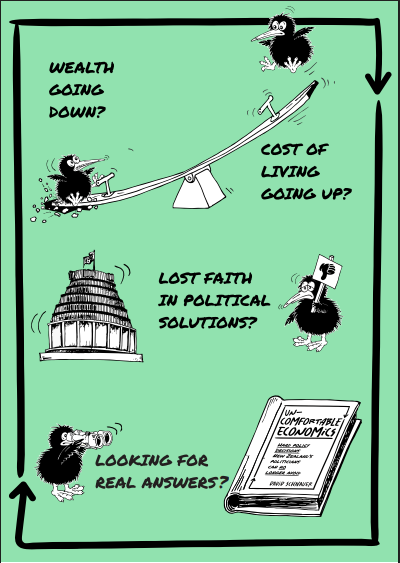
Uncomfortable Economics explores two connected challenges. The first is societal: Kiwis need to develop a heightened focus on building a successful economy. They need to care as much about New Zealand building a winning economy, as they care about the All Blacks winning on the sports field. The book discusses how to lift the importance Kiwis attach to economic progress, work, and wealth creation.
The second challenge is political: the policy settings required to support long term growth. No longer can New Zealand’s politicians avoid the hard decisions they have ducked for decades. Unaffordable superannuation and healthcare; inadequate institutional saving; overpriced houses: banking and tax policies which penalise the real economy; chronic government deficits, disappointing government services. In Part 2, the book lays bare the shortcomings of present policies and suggests constructive alternatives. Positive suggestions for change are surely needed in election year 2026.

What inspired you to write the book?
I’m a retired Auckland lawyer living in Auckland. I hold an economics degree in macroeconomics, in addition to my legal qualification. I’ve enjoyed a lifelong interest in economics and since retirment, have written economic articles; an on-line book, and now written Uncomfortable Economics, issuing mid-2026.
With economic progress having been disappointing over my lifetime as a Baby Boomer, I don’t believe I’m leaving New Zealand in as good a position as I inherited 75 years ago. From being one of the most prosperous nations in 1950, NZ has drifted slowly backwards down world tables of living standards. These real economic concerns drove my motivation to write Uncomfortable Economics.
What research was involved?
I regularly read a lot of economic material and frequently discuss economic issues with other similarly interested people. So I utilised my base economic knowledge as a starting point. Then as I wrote on each different chapter topic, I used internet research to provide more detail as needed.
What was your routine or process when writing the book?
After a career as a lawyer, longer hours of concentration on more challenging topics becomes easier. I always worked from home and have a separate office which I would spend maybe 6 or even 8 hours per day. My book has 20 chapters, and I found in a good week I could write a shorter chapter; while the odd chapter took longer, up to two weeks.
What are some of the key things you cover?
My key message- the NZ economy is unbalanced. For the last 50 years Kiwis have seen house price appreciation as the way to get ahead in life. Get on the housing ladder and wait for your equity to increase, as your house value increases. That means Kiwi wealth is now predominantly held in houses, while our commercial sector is significantly owned from overseas.
That existing NZ conventional wisdom has to be reversed for the next 75 years. Kiwis need to come to believe houses are unlikely to appreciate much further and instead come to think the way to get ahead in life in the future, is to work harder, save more through KiwiSaver, and build your wealth through a large KiwiSaver balance.
Large KiwiSaver savings balances provide domestic capital for NZ to develop its real economy and its infrastructure. They also eventually see retirees supporting themselves more in retirement, thereby taking pressure off stretched government budgets.
That is the key change in overall direction which my book seeks to promote for the NZ economy.
What did you enjoy the most about writing Uncomfortable Economics?
Researching the various areas I covered in the book. I was also determined to write a reader-friendly book which informed readers can easily understand. It was a real challenge to transition from writing legalese, to writing easily read copy which nevertheless suitably describes complex economic situations and arguments. Whether I fully succeeded in this objective of writing simply, is ultimately for my readers to decide.
What did you do to celebrate finishing this book?
Unexpectedly, I found stopping writing quite difficult, because I would wake up the next day with another thought, and want to go back and change one of my chapters a little. This happened rather too often, until I finally had to say to myself “Enough is enough”. So stopping writing was a time of mixed feelings- relief I had finished, but concern there was always something which could be spelt out better.
What is the favourite book you have read so far this year and why?
I just finished and enjoyed very much “1929” by Andrew Ross Sorking, published by Allen Lane in 2025. It is an excellent new non-fiction book on the origins of the 1930’s Great Depression. Why did I enjoy it? Because it is really well researched and written (it took eight years to write- longer than Samuel Johnson took to write his first dictionary). It describes the events of the 1920’s in USA including the dramatic share market crash of Thursday 24 October1929. The book chronicles these events by going into detail about some of the principal Wall Street figures of the day and their actions during the period. In my assessment this “humanizing” of the events in the book, rather than simply giving a cold factual economic analysis of what happened, is critical to its success.
It may shock some NZ Booklovers readers, when I say I hardly ever read fiction. But then I don’t need to. “1929” shows that truth can be just as gripping and certainly on occasion just as strange as fiction.
Mary Egan Publishing


