
Interview: Chard Pawley talks about Orion Rising


Chard Pawley joined the merchant navy at seventeen and earned his captain’s stripes by twenty-nine—a role he still commands today. His career has taken him across the globe on container ships, charter boats, and offshore vessels, visiting ports in every ocean. A lifelong mariner and self-professed history nerd (with the degree to prove it), Chard draws on two decades at sea to bring grit, realism, and atmosphere to every story he writes.
His debut series, The Commonwealth Collection, blends high-stakes adventure, survival, and near-future intrigue, drawing on a career spent staring down the horizon. Chard talks to NZ Booklovers about the first book in the series, Orion Rising.
Tell us a little about Orion Rising.
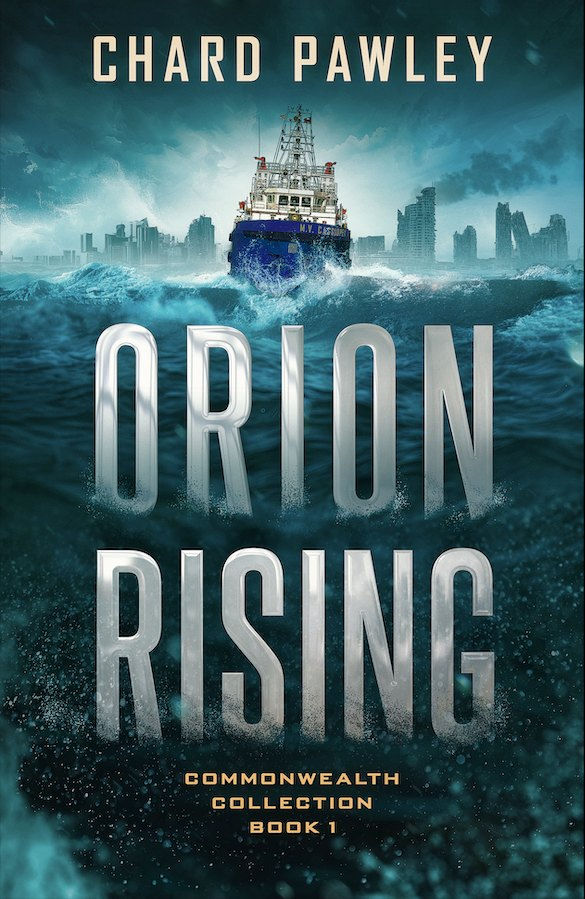
Orion Rising is a near-future thriller set in 2080, sixty years after global wars and environmental collapse have rendered much of the planet uninhabitable. What remains of humanity is concentrated in the southern hemisphere, split unequally between the affluent Commonwealth and the more precarious Fringes.
With little arable land left, survival has shifted offshore. Colossal sea-rises and vast networks of floating farms now sustain human life, turning the ocean into a lifeline for civilisation, but one that is vast, loosely governed, and thinly policed.
The story follows Orion Trayfer, a second officer aboard an offshore vessel servicing these installations. When a friend’s death at sea raises more questions than answers, Orion is pulled into an investigation that quickly escalates beyond anything he expected—uncovering a covert flow of people and influence moving through New Zealand’s porous maritime borders, and a chain of events that threatens not only his own life, but the fragile balance between the Commonwealth and the Fringes.
Alongside him is Samara, a newly assigned trainee with a sharp mind and a guarded past. She teams up with Orion in his search for answers, but her presence brings new complications, forcing him to confront parts of himself he’s long avoided, even as her own secrets begin to surface.
What inspired you to write this book?
I’ve always loved a good thriller, so it felt natural to set one in an environment I know best—the sea.
The original seed for Orion Rising was planted when I was towing barges loaded with sections of a gas platform from Singapore to Australia. Watching these enormous structures being assembled offshore, piece by piece, made me realise what humans are capable of building in remote, hostile environments when the need is there. That’s where the idea of the Sea-Rises came from.
On the same contract, I found myself staring at those large barges and thinking how easily someone could hide aboard them. Not comfortably, but effectively. It felt like a plausible and unsettling way of slipping across borders unnoticed, and that idea stayed with me.
Layered on top of that is the disparity between nations I observed early in my career, something that has never left me. I’ve been to places where thousands of labourers work in unsafe, under-regulated conditions for very little pay, and then returned to Australia and New Zealand, where regulation, affluence, and safety are the norm.
That imbalance is impossible to ignore, and forces you to ask uncomfortable questions. In Orion Rising, it is that inequity which forms the political backbone of the story and drives its central conflict.
What research was involved?
Everything relating to the vessels—the descriptions, procedures, navigation, and towing operations—comes directly from real-world experience. The same goes for the feel of life at sea: the rhythm of watches, the isolation, the changing states of the ocean, and the contrast between the places you visit.
The offshore farms and sea-rises are extrapolations of infrastructure that already exists. I’ve taken what we’re building today and projected it forward a few decades, applying a degree of poetic licence where needed, but keeping it grounded in reality.
Where I did need to research more deeply was in how such a world could function. I wanted the solutions in Orion Rising to feel plausible, not speculative for its own sake. That meant looking into soil-less agriculture, gene-edited crops capable of saltwater uptake, aquaponics systems for protein production, and large-scale desalination. Even the energy systems, such as micro-fusion, are based on technologies that are experimental, but rooted in real science.
Crucially, there are no magical AI fixes. Just extrapolated science pushed to the limits.
I also had to map the characters’ movements—where they travel, the distances involved, and how long these journeys would realistically take. To keep the timeline consistent, I created a fictional passage plan. Rather than relying on electronic charts, I worked it out the old-fashioned way, plotting it by hand on paper charts and swinging dividers across them to run the calculations.
What was your routine or process when writing this book?
Usually my writing starts with a single scene, something my mind keeps returning to. For Orion Rising, it was the image of Orion going over the side of his ship into a raging sea. At first, everything around that moment is blurred. It’s only by getting that scene down on paper that I have the mental bandwidth to allow the rest of it to come into focus.
Once it’s there, the questions start to open things up. Why did he go in the water? What’s the threat? Where exactly is this vessel? From there, I begin to widen the lens—meeting new characters, discovering the edges of the world, and uncovering the deeper shape of the story.
My actual process is quite physical. I have to walk and think before I write. Sometimes with music, but never anything that steals my attention. As I walk, the story plays out like a film in my head, and only after I’ve watched it can I sit down and write.
When I do sit down, it all tends to come out in a rush. The first draft is rough, just getting it onto the page. Then comes the real work. I go back through it again and again, tightening, refining, shaping. That’s the part I enjoy most, watching the prose sharpen and the story take its final form.
If a soundtrack were made to accompany this book, name a song or two you would include.
I write with instrumental soundtracks playing in the background. Hans Zimmer and Max Richter are my go-to composers—they help carry the emotional weight of a scene without pulling my focus away.
Hans Zimmer’s Mountains from Interstellar would be one. There’s a relentless sense of time slipping away in that piece, of pressure building, tension tightening, all of it driving toward a final release. It mirrors the kind of moments in the book where everything feels like it’s closing in.
Max Richter’s To the Stars from Ad Astra would be another. I can picture it playing as Orion stands on deck, staring out at a horizon thick with a brewing storm, with that quiet, heavy awareness that he’s sailing into something inevitable.
If your book were made into a movie, who would you like to see playing the lead characters?
With an unlimited chequebook, I’d cast Timothée Chalamet as Orion, as he has that mix of intensity and vulnerability that fits the role perfectly.
For Danny, I’d go with a grizzled, bearded Brad Pitt. Someone who can carry experience, weight, and a bit of wear-and-tear without needing to say much.
And for Samara, the British actress Naomi Scott, known for Aladdin. She has the presence and edge to bring that character to life exactly as I imagine her.
What did you enjoy the most about writing this novel?
I love seeing the story take shape and come to completion. I usually begin with broad strokes, but it’s in the details where things come alive, and also where the surprises happen. Characters start doing or saying things I hadn’t planned, and sometimes the outcome shifts entirely from what I first imagined.
It’s a bit like working with clay. You start with a clear idea of what you’re trying to make, but as you shape it, it takes its own form. The final result is never exactly what you envisioned, and that’s the part I enjoy most.
There’s something deeply satisfying about watching a story evolve from a rough idea into something complete, something that feels real. By the end, it’s no longer just something I set out to write, but something I’ve discovered along the way.
What did you do to celebrate finishing this book?
I shared a whisky with my wife and we talked about the next book idea.
She’s an author as well, so throwing around plots and characters is just the language we speak in. Finishing one story never really feels like an ending. It’s more like a handover to the next.
My wife’s the reason Orion Rising ever became a fully realised novel, and ultimately the reason it made it to print.
What is the favourite book you have read so far this year and why?
So far this year, my favourite read has been Project Hail Mary by Andy Weir.
It’s science fiction that stays as grounded in reality as possible, but never at the expense of pace or heart. The problem-solving feels real, the stakes feel enormous, and it’s one of those rare books that manages to be both tense and genuinely funny at the same time.
At the centre of it are two incredible characters whose relationship becomes the heart of the story, and is easily the best intergalactic bromance I’ve ever read. It’s clever, emotional, and surprisingly uplifting for a story about the end of the world.
What’s next on the agenda for you?
In between captaining, I’m now into the editing phase of Scylla Burning, the sequel to Orion Rising.
At the same time, I’m working on a middle-grade story inspired by my son, who loves anything to do with space and dinosaurs, so that’s been a fun shift in gears.


